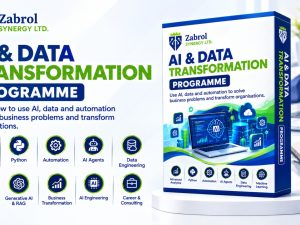
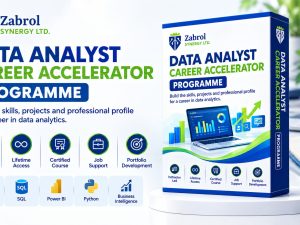
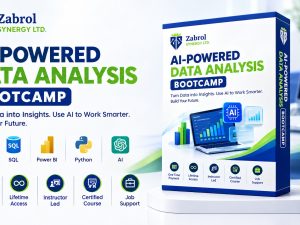
This intensive 8-Weekend Data Analysis & Business Intelligence Mastery is designed to equip learners with the practical skills needed to collect, prepare, analyse and visualise data to support business decision-making.
Participants will learn the complete data analysis lifecycle, covering:
The programme combines instructor-led sessions, hands-on workshops, real-world business case studies and a capstone project to ensure learners gain practical experience using industry-standard tools and techniques.
A detailed breakdown of all modules, learning outcomes, assessments and project work can be found in the Curriculum section.
Key Benefits
Whether you are looking to start a career in data analytics, enhance your current role, or improve your ability to make data-driven decisions, this programme provides a structured pathway to becoming a confident and effective Data Analyst.

Overview
Organisations across all sectors generate large volumes of data from customers, operations, finance, marketing, supply chains and digital platforms. To remain competitive, businesses need professionals who can extract value from this data and support decision-making through analytics and business intelligence.
The Data Analysis & Business Intelligence Programme provides a practical, hands-on introduction to the complete data analysis lifecycle, including data governance, data preparation, statistical analysis, predictive analytics, dashboard development and stakeholder communication.
Learners will gain experience using industry-standard tools such as:
Microsoft Excel
SQL
Power BI
Python
Jupyter Notebook
Data Visualisation Tools
Through practical exercises, real-world case studies and a capstone project, participants will develop the ability to deliver end-to-end analytical solutions that support organisational objectives.
Peter Okolie is a Data Analytics, Business Intelligence, and Digital Transformation professional with extensive experience in designing and delivering training programmes that equip individuals and organisations with practical, industry-relevant analytical skills. He has worked with professionals across diverse sectors, helping them leverage data to improve decision-making, operational efficiency, and business performance
There are various learning instruments integrated throughout the programme to ensure learners develop both theoretical knowledge and practical data analysis skills. These learning instruments are designed to work together to provide a comprehensive and engaging learning experience.
Participants will understand:
In this module, we will cover Data legislation, Data Security, Data Classification, as well as Privacy by Design

Data legislation refers to the laws, regulations, and standards that govern how organisations collect, store, process, share, and protect information.
These laws are designed to:
Protect individuals' privacy and rights
Ensure organisations handle data responsibly
Reduce the risk of misuse, fraud, and data breaches
Promote transparency and accountability
Build trust between organisations and the public

Data security protects organisational and personal information.
The CIA Triad (Confidentiality, Integrity, Availability) underpins information security.
Cyber threats continue to evolve.
Strong passwords and MFA are essential controls.
Access should follow the Principle of Least Privilege.
Security incidents must be reported immediately.
Everyone has a responsibility for protecting information.
Good security practices support compliance, trust, and organisational success.
By the end of this lesson, learners should understand that data classification is more than applying labels—it is a fundamental control that protects information, supports legal compliance, and enables responsible data analysis.
As future data analysts, participants should be able to identify the sensitivity of data, apply the appropriate classification, and ensure that data is handled, stored, shared, and disposed of in accordance with organisational policies and legal requirements.
Privacy by Design is a proactive approach to protecting personal information. Rather than treating privacy as a compliance exercise, organisations should build it into every stage of a project—from planning and data collection to analysis, reporting, retention, and disposal. For data analysts, applying Data Minimisation, Purpose Limitation, effective Consent
Management, and conducting Data Protection Impact Assessments (DPIAs) are essential practices that reduce risk, support legal compliance, and foster trust in data-driven decision-making.
Participants will understand how data moves through organisations and how databases support analytical work.